
AI for Sustainability Poster Session: 2026 MCSC Member Meetings
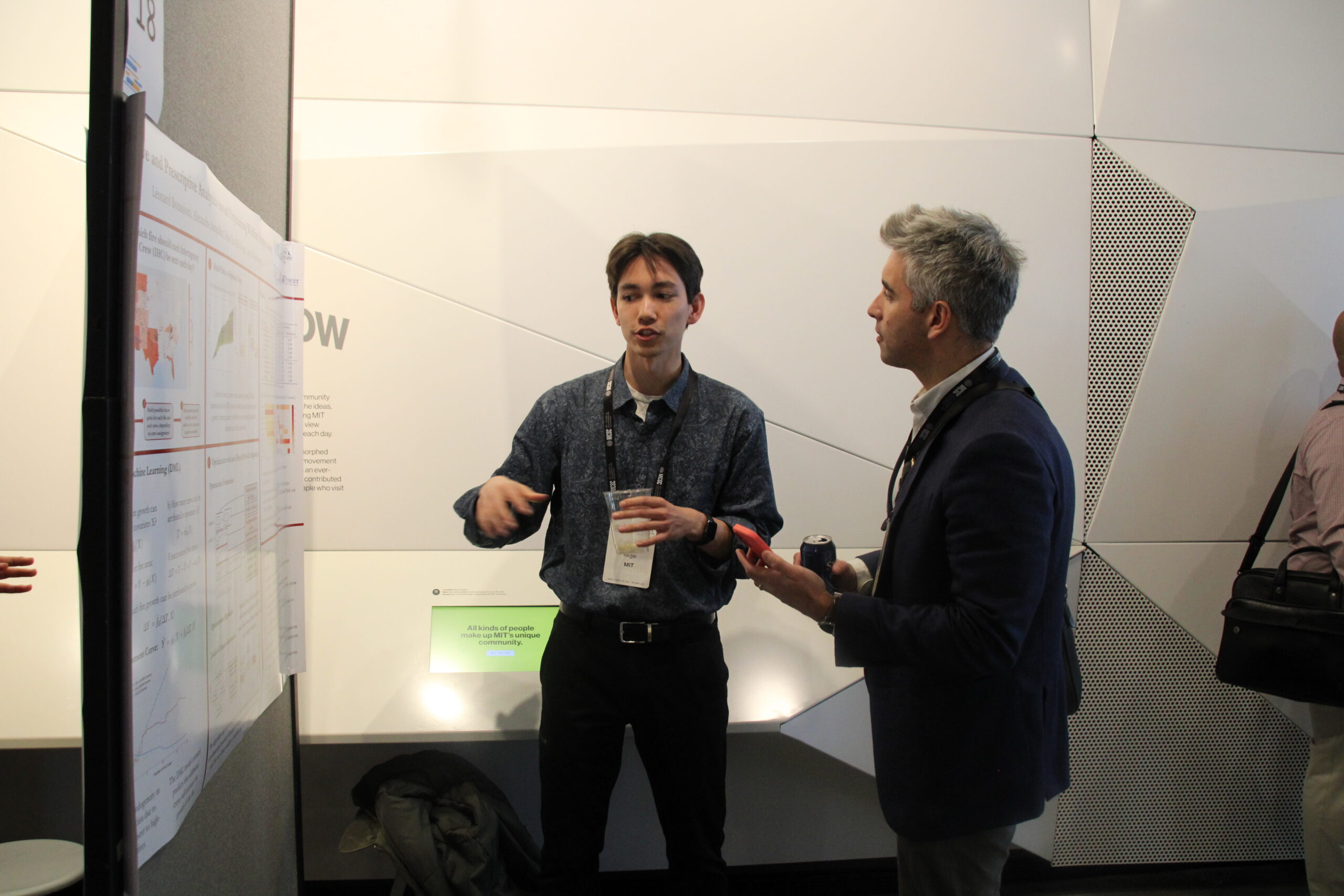
This is a subset of posters from the 2026 Poster Session, presented by MIT community members. Posters focused on applications of artificial intelligence for sustainability.
Kellen Peitl & Shreya Dungarwal
Heat Alert+ is an advanced heat warning and decision-support system designed to empower Boston-area Community Health Centers with daily insights, proactive alerts, and patient-centered recommendations during extreme heat events. The platform enables health administrators to:
- Monitor heat risk at a hyper-local level
- Identify at-risk patient populations
- Receive customized alerts and reports
- Deliver clinically validated guidance directly to patients

Khai Nguyen, Petros Ellinas, Anvita Bhagavathula, & Priya L. Donti
Cheap data goes a long way toward improving machine learning-based optimization and simulation. We propose a novel framework that first collects “cheap” imperfect labels, then performs supervised pretraining, and finally refines the model through self-supervised learning to improve overall performance. We empirically validate our simple three-stage strategy across challenging domains, including nonconvex constrained optimization, power-grid operation, and stiff dynamical systems, and show that it yields faster convergence; improved accuracy, feasibility, and optimality; and up to 59x reductions in total offline cost.

Shareholder Proposals are critical corporate governance provisions that enable investors to initiate referendums on corporate elections. We study the two intertwined channels for their financial implications: Information and Implementation. We find that shareholder proposals add value by uncovering new information. However, their implementation is costly. Investors exert exactly the right amount of oversight on firms regarding corporate governance, but pressure too much from a financial perspective on environmental and social dimensions.

Laurent Liote, Chadwick Holmes, Daniel Hussmo
Circularity policies can be broadly conceived as policies that support “regenerative systems in which resource input and waste are minimized by slowing, closing and narrowing material and energy loops”. These policies are seen as a key pillar of the global transition towards a more sustainable future and often encourage the creation of circular ecosystems at industry level. Building on existing work by the authors, this poster investigates how agentic artificial intelligence (AI) can support circularity policymaking. We show how we designed an agentic AI workflow and set-up AI agents to model how EU circularity policy changes could affect joint-ventures between 20 leading sustainable companies in Sweden. This includes testing how changes in tax modulation, subsidy schemes and market access regulation could impact existing and potential circularity joint ventures between companies. We visualize our results to show how the circularity partnership scores between the companies change as the result of circular policy changes. Using the partnership that benefits the most from circular policy changes as an example, we highlight how our AI tool can help policymakers and companies analyze the impact of proposed circularity policies. This poster contributes to an ongoing discussion on how agentic AI can support circularity and makes contributions to circularity policy design and implementation.

Jonathan M. Broyles, Florian Berg, Caitlin T. Mueller, & Jeremy R. Gregory
Corporations with extensive supply chains often lack pathways to decarbonize scope 3 greenhouse gas (GHG) emissions. Recently, environmental attribute certificates (EACs) have been proposed as a market-based mechanism for corporations to purchase the environmental attributes of a low-carbon commodity, even if it is disconnected from the corporation’s physical supply chain. This poster presents ten industry-agnostic recommendations to ensure fair EAC markets and evaluates the GHG emission savings when implementing a concrete EAC using the case study of a hypothetical data center. The case study relies on the cement and concrete EAC framework to identify EAC-eligible concrete mixtures during the design process of the data center, noting that a 76.5% GHG emissions reduction is possible.

Chloe Hong, Alexandra Schild, Caitlin Mueller, Gerard de Melo
Perception-driven and performance-driven design spaces have long operated in isolation. While recent advances in generative AI enable the interpretation of abstract design concepts and their translation into visual forms, these outputs lack physical grounding and material efficiency. Conversely, performance optimization algorithms remain blind to perceptual qualities, with no means of evaluating or shaping design intent. This project bridges that gap by introducing editable programs as a mediating representation between the two domains — capturing the expressive flexibility of perception-driven design while enabling physics-informed analysis and systematic optimization. This shared grounding unlocks two key capabilities: translating design intent into physically meaningful terms, and steering design articulation based on performance criteria.

Sandeep Mangat, Amanda J. Bischoff, and Darcy L. McRose
Nitrous oxide (N2O) emissions from agricultural soils have high warming potential and are difficult to mitigate. The vast majority of N2O emissions in cropland are driven by microbes through nitrification and denitrification. Synthetic nitrification inhibitors (SNIs), designed to increase the lifetime of ammonia (NH3) in soil and therefore decrease N2O emissions due to nitrification, were first produced in the 1960s. Plant-produced ‘biological nitrification inhibitors’ (BNIs) have emerged more recently. Both SNIs and BNIs are thought to act on the oxygen dependent Ammonia Monooxygenase (AMO) enzyme encoded by nitrifying microbes. Questions remain about the efficacy of both SNIs and BNIs, especially under anoxic conditions, and whether they have off-target impacts on the surrounding environment. We have demonstrated that there are differences in the efficacy of NIs in reducing N2O emissions under low and high oxygen tensions. We are also investigating the toxicity of NIs toward soil microbes that do not perform nitrification.
Mayar Ariss, Fergus Mok, Paolo Santi, Carlo Ratti
During the 2025 Palisades fire (the costliest on record) water systems failed under surging demand. This research introduces an AI agent with cognitive memory and LLM processing, designed to autonomously optimize water distribution by interpreting real-time emergency radio chatter and tracking the evolving ground situation. This raises a critical question: how much decision-making should we entrust to AI in high-stakes emergencies, and where must humans remain in the loop?

This poster shares the design and development process of a now publicly available GPT Agent to analyze and redraft corporate biodiversity commitments. This GPT Agent was subsequently used to analyze 14 sustainability reports of MCSC Member Companies and evaluate the robustness of 154 biodiversity commitments and found only three fully robust commitments. We then identified recommendations for creating more robust biodiversity targets and created a data dashboard where companies can compare and evaluate commitments between MCSC companies and sectors.

Artur Lyssenko, Lauren Chua, Sauradeep Majumdar, and Rafael Gómez-Bombarelli
This poster provides a brief overview of developing machine learning-driven molecular simulation workflows for sustainable material discovery, specifically for decarbonization and energy-efficient polymer manufacturing. Furthermore, the importance of generating tailored high-quality data has been outlined, with molecular reactivity datasets as an example.
