
2025: A Year in Review
December 3, 2025

The MCSC is grateful for a productive 2025—full of collaboration and innovation made possible by the dedication and hard work of our member companies and our research and administrative teams!
Co-Developing Technology with Industry Feedback
Throughout the year, the MCSC’s interdisciplinary researchers shaped and propelled our work based on the priorities and feedback of member companies.

Team of MCSC Impact Fellows.
Danika Eamer made significant updates to Geo-TIDE, a digital tool she developed to help trucking industry stakeholders optimize where and how to decarbonize their fleets by transitioning to low-carbon energy carriers. She released a technical guide and case studies to detail these updates and the tool’s functionality, as well as to showcase real-world usage scenarios and explore the methodology behind its development. Over the summer, the data files that Geo-TIDE integrates became accessible on Amazon Web Services (AWS) to support better information sharing. This fall, to recognize her work on Geo-TIDE and celebrate how the tool uses open data for impact, Danika was awarded the MIT Prize for Open Data.
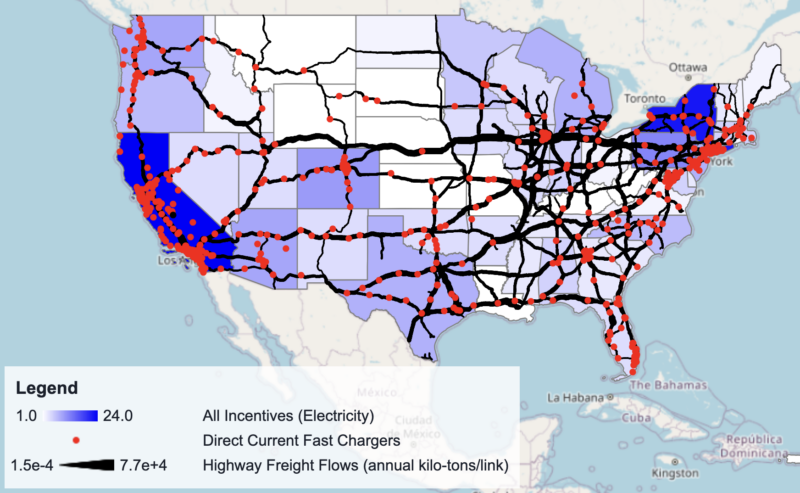
Snapshot of the Geo-TIDE tool.
MCSC-Associated Start-up on the World Stage
Pixelframe, a modular constructive system that allows concrete building elements to be disassembled and reused, was also developed with MCSC member company input. In 2025, Professor Caitlin Mueller, MCSC Associate Director, and her team, showcased Pixelframe at the Venice Biennale’s 19th International Architecture Exhibition (curated by Carlo Ratti), the largest architecture festival in the world. This was an opportunity to share Pixelframe with on a global stage – with curious and action-oriented scholars, experts, practitioners, and students.
The Pixelframe team also recently announced the completed fabrication of a full-scale prototype, a Pixelframe beam designed to span 6 meters. The completion of the beam marks a jump from half-scale fabrication and testing in the lab spaces of MIT to industry-scale proof-of-concept prototyping.
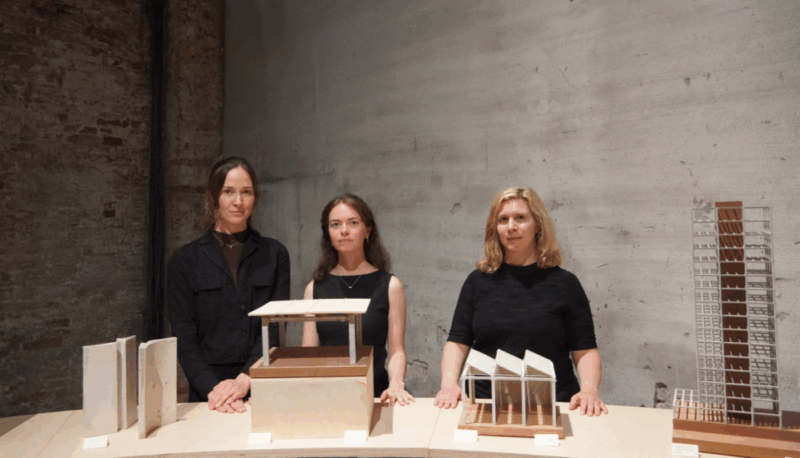
Inge Donovan, Jenna Schnitzler, and Professor Caitlin Mueller at the 2025 Biennale. Photo by Future Assemblies.
Progress: Pooled Funding Outcomes & Initiatives
The MCSC continues to bring researchers and industry experts together to collaboratively dive into important decarbonization opportunities. As one example, a white paper, co-authored with member companies, explores how to overcome key barriers to decarbonizing trucking. Together, the MCSC’s Danika Eamer and industry representatives from Accenture and Prologis illustrate the economic and functional benefits of pooling infrastructure investment and call for the establishment of an industry consortium that is dedicated to facilitating the planning and deployment of pooled charging infrastructure.

A white paper co-authored with MCSC member companies explores overcoming barriers to decarbonizing trucking.
The MCSC’s 2024 Seed Award projects have also presented many opportunities for member companies to work directly with MIT faculty and make progress together. Through a series of workshops in 2025, MIT faculty leading the seed projects shared their findings and explored next steps, while MCSC member companies provided the critical industry perspective needed to help make the work implementable and scalable.
2024 Seed Awards projects:
- Optimization and Collaboration Toward a Scalable Charging Infrastructure in Logistics (PIs: Amin & Jacquillat)
- Global Mapping of Groundwater Recharge and Sustainable Aquifer Water Withdrawals Using Satellite Observations (PI: Entekhabi)
- Gaining Green Premiums from Decarbonizing the Built Environment: A Holistic Evaluations Approach for Low-carbon Investments (PIs: Zheng & Rigobon)
- Reducing Embodied Carbon @ Work: Low-carbon Cement-based Product Strategies for Data Centers, Warehouses, and Industry (PI: Kirchain)
- Optimizing Biological Nitrification Inhibitors for the Suppression of N2O Emissions from Agricultural Soils (PI: McRose)
- Employing AI to Sort Plastic Waste by Manufacturer (PI: Olsen)
- The Impact of Weather on the Retail Industry: Long and Short-term Impacts (PIs: Perakis & Tamarin-Brodsky)
- Improving Additionality Assessment in Voluntary Carbon Markets (PI: Rigobon)
- Hyperspectral Remote Sensing of Soil Organic Carbon Using Machine Learning (PI: Wang)
Throughout 2025, we also celebrated many outcomes that emerged from our 2022 Seed Awards projects. A few examples:
- Fabricated a fully biodegradable and hydrophobic (crucial in blocking water vapor) film out of completely natural materials with a simple process. The team (Kripa Varanasi, Edmond Lam, Shreya Agarwal)’s goal was to achieve full biodegradability for circularity in packaging solutions.

- Identified three possible replacements for polyester, a textile that does not easily decompose, and addressed common challenges in how they might be scaled (Bradley Olsen, Gregory Rutledge, Natalie Mamrol, Katharina Fransen).
- Provided guidance on regionally tailored siting strategies for utility-scale renewable energy infrastructure and has linked spatial siting to improved system-wide performance. Their research (Michael Howland, Liying Qiu) was published as a cover article in Cell Reports Sustainability.
- Found that developers, architects, engineers, and investors are interested in understanding the practical applications of circularity in building practices, but the perceived high cost and risks present significant hurdles (Siqi Zheng, Randolph Kirchain, Fabio Duarte, Juliana Berglund-Brown). Their work was published in npj Urban Sustainability, a Nature-family journal.
- Explored how decreases in seed-dispersing animals can lead to a major reduction in forest carbon absorption (Evan Fricke, Charles Harvey, César Terrer, Susan Cook-Patton). Their work was published in PNAS.
Central Theme: Gen-AI
Computing took center stage in many sustainability discussions in 2025, and MCSC was glad to lead efforts to explore the real opportunities and track emergent needs for a broad set of stakeholders. Noman Bashir led the charge on data and computing, a central theme that will continue for MCSC into 2026. Through MIT’s Undergraduate Research Opportunities Program (UROP), Noman worked with Wacuka Ngata to investigate the ecological impact of data centers – publishing a conference paper on this topic in July. Earlier in the summer, Noman shared his perspectives on the consequences and benefits of generative AI on climate, and where we are headed, on FOX 13 Seattle.

Noman Bashir was featured on FOX 13 Seattle in June.
We were also pleased to welcome our newest member company, GE Vernova.
Outlook for 2026
Looking to the new year, we are excited to drive toward accelerating the implementation of real-world solutions to pressing climate and sustainability challenges. This is manifesting as a shift toward follow-on funding from earlier seed awards to support the deeper development of promising technologies and synergistic discoveries whose findings are of great interest to our member companies. Emerging themes include the economics of decarbonization, resilient supply chains, data centers, textiles and agriculture. These topics will shape the conversations at our upcoming member meetings in the spring, just before Earth Day. We are excited to welcome MCSC member companies and the MIT community to campus for those workshops, which will be outcome oriented.
We look forward to shaking up the climate and sustainability space and remain steadfast to our articulated commitments to change the world.
We are eager to continue to drive impact via critical industry-academia partnerships, and we are grateful for your leadership in supporting that effort.
With sincere wishes for a joyful and productive 2026,
The MCSC Team

The MCSC's Long-Term Impact